Plants That Really Grow Here
Turk’s Cap: A Welcome Splash of Color for the Shadier Garden
Every Garland garden seems to have a difficult spot: morning light, afternoon shade, tree roots nearby, and a gardener wondering what might actually bloom there. Turk’s cap deserves a place on the list of possibilities.
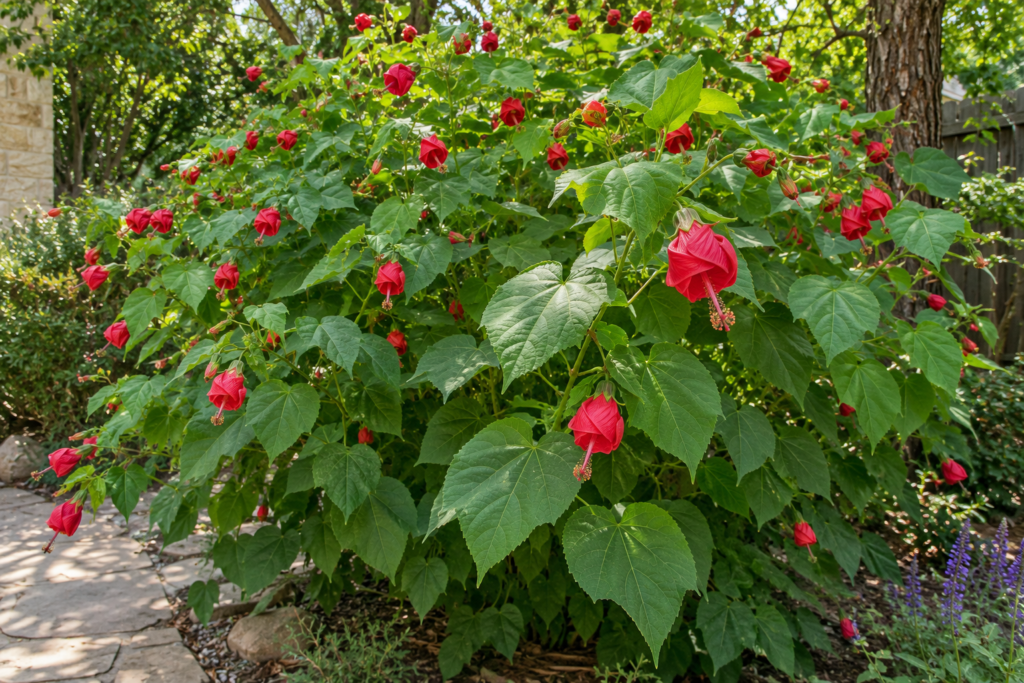
The familiar red-flowered Texas native, commonly labeled Malvaviscus arboreus var. drummondii, has an informal, leafy appearance and distinctive flowers. Its petals remain wrapped around a projecting central column, giving each bloom the look of a tiny rolled umbrella. It brings color without needing the large, open flowers we usually associate with its hibiscus relatives.
Its tolerance for shade is a major advantage. Turk’s cap can grow across a range of light conditions, including partial shade. North Texas’s regional Texas SmartScape plant directory lists it as a perennial suited to sun, partial shade, or full shade. That flexibility makes it useful when a yard offers more tree canopy than open sky.
For a first planting, consider a location with morning sun and protection from the harshest afternoon exposure. Watch the site before digging: “shade” beside a bright east-facing wall is different from the darkness beneath a dense evergreen.
Give the plant room to develop. Turk’s cap has a loose, shrubby habit, so it works better as a generous clump than as a tightly clipped little border. Place it behind shorter plants, near a fence, or along the edge of a shaded sitting area. University of Texas botanical information describes plants commonly reaching three to six feet tall, although conditions influence their eventual size.
Water new plants attentively while their roots establish. Check moisture beneath the surface rather than assuming a shaded bed stays damp. Tree roots can compete strongly for water, and rainfall does not always reach soil beneath a thick canopy. Keep mulch away from the base of the stems.
The flowers also add movement to the garden by attracting visitors. Oklahoma State University identifies Turk’s cap as a nectar source for hummingbirds, butterflies, moths, and other insects, with fruit attractive to wildlife.
Expect seasonal change. Freezing weather can kill back the top growth; a bare winter appearance does not automatically mean the plant has died. Avoid assuming that every taller tropical mallow sold under a similar common name has the same hardiness.
Design idea: Plant Turk’s cap where its red flowers can be seen from a favorite window. Leave space around the clump, add a simple mulched path, and let the plant’s natural shape do the decorating.